Early in an engineering career, references to documents like ASME Section VIII, API 510, or ASME B31.3 frequently appear. Colleagues debate which edition governs a particular repair, or whether a piece of equipment is truly “code compliant.” These are not procedural formalities. Codes and standards form the technical and legal foundation on which safe process facilities are built and maintained.
They exist because engineering decisions carry real consequences. The knowledge embedded in these documents reflects decades of accumulated experience, much of it from incidents involving equipment failures that resulted in fatalities, fires, or environmental damage. Whether your work centers on design, inspection, mechanical integrity, or project engineering, understanding which document applies and what it requires is a fundamental part of an engineer’s job.
What Do All These Terms Actually Mean?
Codes vs. Standards
A code provides mandatory design rules: the calculations, material requirements, and construction requirements that must be followed to build or repair something safely. Codes establish minimum acceptable criteria.
Examples of Codes:
- ASME Section VIII, Division 1 and Division 2 (pressure vessels)
- ASME B31.3 (process piping)
- ASME Section I (boilers)
A standard provides dimensional, material, or performance specifications intended to ensure interchangeability and consistency. Where a code tells you how to determine whether something is structurally adequate, a standard tells you what it should look like or be made of.
Examples of Standards:
- ASME B16.5 (flanges)
- API 5L (line pipe)
- ASME B16.34 (valves)
In practice, codes incorporate standards by reference rather than reproducing their requirements, so understanding a code often means following a chain of referenced documents.
Construction Codes vs. In-Service Codes
Construction codes govern how equipment is designed and built. They apply at the time of manufacture and cover materials, fabrication, inspection, and testing.
Examples of construction Codes:
- ASME Section VIII Division 1 and Division 2 (pressure vessels)
- ASME B31.3 (process piping)
- API 650 (aboveground storage tanks)
In-service codes govern how equipment is inspected, assessed, repaired, and maintained once it has entered service.
Examples of in-service Codes:
- API 510 (pressure vessels)
- API 570 (piping systems)
- API 653 (storage tanks)
- NBIC NB-23 (boilers, pressure vessels, piping, and pressure relief devices)
A third category is fitness-for-service (FFS) standards, which provide methods for evaluating damaged or degraded equipment and determining whether it can safely remain in operation. The primary FFS standard in the process industries is API 579-1/ASME FFS-1.
RAGAGEP
RAGAGEP stands for Recognized and Generally Accepted Good Engineering Practices. Under OSHA’s Process Safety Management regulation (29 CFR 1910.119), facilities handling hazardous chemicals must document that their equipment complies with RAGAGEP. Industry codes and standards, particularly those published by ASME and API, are the primary embodiment of that requirement. When someone asks whether equipment is RAGAGEP compliant, they are asking whether it was designed, built, maintained, and inspected in accordance with the applicable codes. If the documentation is missing or uncertain, a compliance gap exists regardless of whether the equipment is performing safely.
Code Editions
Codes are revised periodically, often on a two-to-five-year cycle. A vessel built in 1986 was stamped in compliance with the edition current at that time, which becomes its “code of record.” When that vessel requires repair today, the question of which edition governs the repair work is not trivial. The general principle is that repairs follow the current edition of the applicable code, or the original construction code where most applicable to the work planned. Before beginning a code calculation or repair assessment, always confirm the applicable edition with the Inspector, and when required, the jurisdiction where the vessel is installed. Ensure these items are documented clearly.
Why Does This Matter to My Day-to-Day Work?
The short answer is safety, compliance, and equipment integrity.
Pressure-containing equipment can fail catastrophically when not properly designed, constructed, or maintained. Code requirements, including minimum wall thicknesses, allowable stress values, weld quality standards, and inspection intervals, represent the engineering community’s accumulated understanding of how to prevent those failures.
Beyond safety, many codes carry legal force. OSHA requires PSM-covered facilities to comply with RAGAGEP. Many states and local jurisdictions have boiler and pressure vessel laws mandating ASME compliance for new construction. Insurance carriers require inspection programs aligned with API or NBIC standards. Non-compliance can lead to regulatory citations, facility shutdowns, or loss of coverage.
In many instances, process equipment operates for decades, and in-service codes provide the framework for managing the corrosion, fatigue, and mechanical damage that accumulate over time. Without that structure, maintenance decisions lack a consistent technical basis.
Where Does This Show Up in the Field?
Codes and standards apply to nearly every piece of fixed equipment in a process facility:
- Pressure vessels (reactors, separators, heat exchangers, drums): ASME Section VIII Division 1 or 2 for construction; API 510 or NBIC NB-23 for in-service inspection, repairs, and alterations
- Process piping: ASME B31.3 for construction; API 570 or NBIC NB-23 for in-service inspection, repairs, and alterations
- Aboveground storage tanks: API 650 or API 620 for construction; API 653 for in-service inspection
- Pressure relief devices: API 520 and 521 for sizing and installation; NBIC NB-23 for in-service inspection, repairs, and alterations
- Fired heaters: API 560 for construction; API 530 for tube thickness design; API RP 573 for in-service inspection
- Damaged or degraded equipment of any type: API 579-1/ASME FFS-1
Code knowledge also connects disciplines. Inspection teams rely on in-service codes to develop inspection plans. Process engineers trigger Management of Change (MOC) reviews when operating conditions shift, which often requires re-evaluating affected equipment against code limits. Project engineers write the applicable codes into purchase orders and design documents. It is a shared language, not a specialty.
What Happens When the Paperwork is Missing? (Case Study)
During a mechanical integrity audit at a processing facility, an engineering team identified a group of pressure vessels that had been in continuous service for more than 30 years. When they attempted to retrieve the original design documentation, including the Manufacturer’s Data Report, nameplate records, and code stamp information, much of it was missing or incomplete. Several vessels had no nameplate at all.
Under OSHA’s PSM regulations, the facility was required to demonstrate that all pressure-containing equipment complies with RAGAGEP. Without the original construction documentation, that could not happen. A vessel being built “in accordance with the code” requires not only correct design calculations, but documentation and code stamping as verifiable evidence – missing records are themselves a compliance deficiency.
The engineering team undertook a structured re-documentation process following guidance in the applicable in-service inspection code. This involved detailed non-destructive examination to establish actual wall thicknesses, re-creating code calculations using measured dimensions, conservatively assumed material properties, and weld joint efficiencies for the determination of the maximum allowable working pressure (MAWP) and minimum design metal temperature (MDMT). A documentation package was also prepared to substitute for the missing originals.
The key lessons: code compliance depends on documentation as much as on engineering; both the construction code and in-service code need to be identified before any meaningful assessment can begin; and retroactively establishing the code basis for undocumented equipment is far more resource-intensive than maintaining adequate records in the first place.
What Do New Engineers Get Wrong?
Codes are a floor, not a ceiling
Meeting the minimum wall thickness or other code requirement does not mean a design is optimized or conservative for its service. Owners routinely limit the materials of construction, apply preferred design details and loadings, and specify fabrication or inspection requirements beyond what the code demands. Exceeding code minimums is generally deliberate.
Code compliance does not confirm fitness for continued service
Code compliance is a statement used to ensure the equipment satisfied the requirements established by the applicable design code during original construction. Once the equipment is placed into service, an operational service history is developed which may have adversely affected or changed the conditions considered during original design. The in-service codes and FFS standards exist precisely to address that gap to confirm the equipment is fit for continued service.
The applicable codes are not always obvious
Facilities may be subject to overlapping requirements: federal OSHA PSM regulations, state boiler and pressure vessel laws, local jurisdiction rules, and insurance carrier specifications. Not all states have pressure vessel laws; some defer to the NBIC, others to API 510 for in-service requirements. The applicable set of requirements depends on location, service, and PSM coverage. Identifying the full regulatory framework early before project kick-off is recommended.
An improper repair can be worse than a known defect
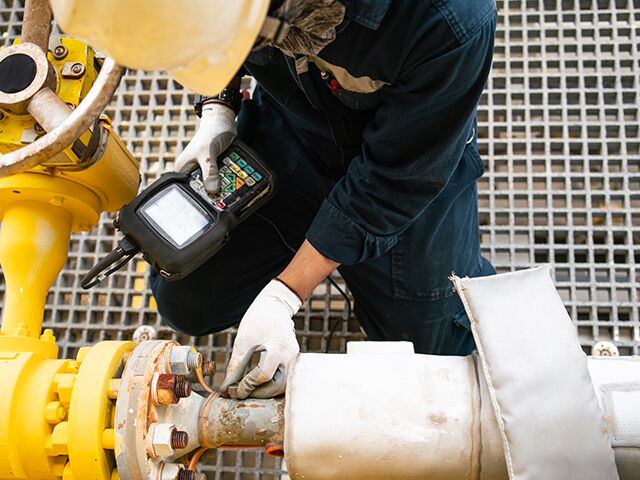
Measured wall thinning is a known condition that can be quantitatively evaluated. An unqualified weld repair, performed with the wrong procedure or without required inspection oversight, may produce a condition that is both worse and less understood than the original defect. Always verify repair procedures against the applicable code, confirm welding is performed under a qualified Welding Procedure Specification (WPS), and ensure all inspection and documentation requirements are satisfied before closing the work.
What Should I Learn Next?
- Code calculations: Start with the design sections of ASME Section VIII Division 1 or ASME B31.3. Understanding how allowable stress values are established and how minimum wall thickness formulas work is the most practical entry point.
- In-service assessment: API 510, API 570, and NBIC NB-23 are accessible introductions to evaluating inspection findings against remaining life criteria and do not require deep prior code knowledge.
- Fitness-for-service: API 579-1/ASME FFS-1 Level 1 assessments rely on screening criteria and straightforward calculations, making them a reasonable next step after gaining confidence with construction codes.
- RAGAGEP and PSM: Understanding how OSHA interprets code compliance, what documentation is required, and how jurisdictions differ is increasingly relevant for engineers in mechanical integrity roles.
Closing Thoughts
Codes and standards are dense documents, but their purpose is simple: they encode the profession’s best current understanding of how to design, build, inspect, and maintain equipment safely. An early-career engineer does not need to memorize every clause. Knowing which code governs which equipment, how construction codes relate to in-service codes, and where to look when a question arises is a strong foundation. The rest builds from there.