Introduction
In the US, the Occupational Safety and Health Administration (OSHA)’s regulatory compliance framework is shifting from reactive compliance to active, data-driven hazard management. Employers face tougher, targeted enforcements; increased electronic injury reporting; and complex heat stress scrutiny under the General Duty Clause. Simply checking boxes is no longer enough to mitigate inspection risks. Stringent requirements are imposed on the design, operation, and maintenance of pressure-containing or structural equipment, particularly within process industries such as chemicals, refining, and petrochemicals.
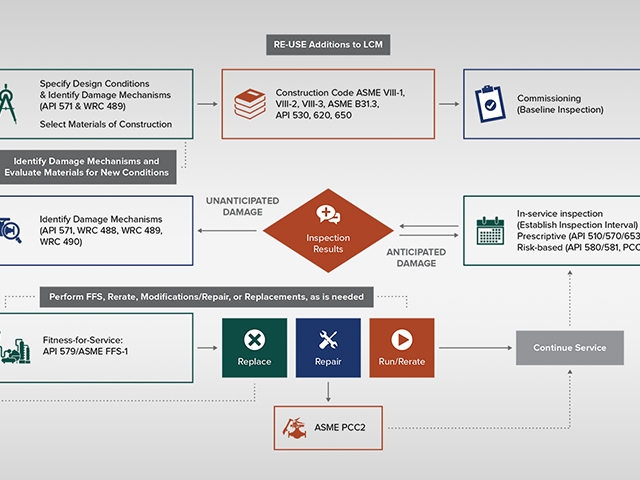
Navigating modern workplace safety requires organizations to view compliance as an operational discipline rather than just an annual review. Success in navigating these mandates depends heavily on sophisticated, multidisciplinary engineering assessments – most notably, damage mechanism reviews (DMRs). As a foundational step in the design and lifecycle management of pressure-containing equipment and structural assets, DMRs are essential for ensuring adherence to applicable safety standards.
This article explores how DMRs facilitate compliance with various OSHA and state regulations and expands upon established scientific methodologies demonstrating their value in process safety management (PSM), asset integrity, and reliability management in the US process industries.
Key advantages of implementing DMRs include:
- Streamlined PSM Compliance: DMRs provide the technical baseline for engineering-intensive PSM elements, significantly improving operational efficiency.
- Cost Optimization: By identifying specific degradation threats early, facilities can avoid over-engineering and reduce unnecessary inspection costs.
- Enhanced Reliability: Integrating DMRs into the design phase ensures that assets are resilient against the specific chemical and physical stressors of their operating environment and reduces uncertainty of asset performance in specific environment
Damage Mechanism Review
A DMR is a systematic, cross-functional evaluation used in industrial facilities to identify credible degradation modes that could compromise asset integrity. It is a proactive process designed to assess the susceptibility of equipment to these mechanisms under specific operating conditions, ultimately informing mechanical integrity (MI) programs and inspection strategies. A DMR is performed to achieve the following:
- Identify potential degradation processes
- Identify damage modes that can result from degradation processes
- Assign degradation rates and susceptibilities to fixed equipment and piping circuits
- Identify the proper inspection technique and method for each damage mechanism
- Help identify, analyze, and enact safeguards to control or mitigate consequences of degradation processes, including integrity operating windows (IOWs)


Sometimes referred to as a corrosion study, a DMR is a structured process performed by a qualified team. To assign corrosion rates, damage mechanisms susceptibilities, and damage potentials for the in-scope fixed equipment and piping, the following information is utilized:
- Materials of construction and inspection history findings
- Process information
- Industry experience
- Input from Process, Operations, and Maintenance teams

For pressure-containing equipment, the DMR is focused on validating the technical feasibility of critical elements of the overall process unit design and operation, forming the basis for:
- Materials of construction selection: Ensures that equipment is constructed from alloys and materials appropriate for in-service environmental conditions, anticipated process streams, and transients
- Weld/joint selection and design: Identifies weld configurations best able to withstand identified mechanisms
- Inspection program design: DMRs identify vulnerable locations or susceptible areas, enabling targeted non-destructive examination (NDE), thickness monitoring, and risk-based inspection (RBI)
- Mitigation and protection strategy: Guides the design of appropriate corrosion inhibitors, cathodic protection systems, coatings, or other mitigation methods.
- Fitness-for-service (FFS) and remaining life assessment: Periodic DMRs support advanced evaluations of existing assets’ integrity and lifespan under OSHA’s MI obligations
Performing a DMR typically follows these six standard steps:
- Obtain data. Collect process flow diagrams (PFDs), P&IDs, material fabrication records, and historical inspection data.
- Develop information. Generate Corrosion Materials Diagrams (CMDs) and define initial corrosion loops.
- Conduct the review. The cross-functional team discusses failure histories and potential new threats.
- Identify specific damage mechanisms. Reference industry standards like API RP 571 to categorize credible damage modes.
- Document results. Create a formal DMR report detailing each loop, expected damage rates, and susceptible locations.
- Implementation. Use findings to set IOWs, update inspection plans, and support process hazard analysis (PHA).

Core Compliance Requirements
OSHA compliance for DMRs and their alignment with PHA is primarily governed by the PSM standard. While federal regulations provide the baseline, specific state plans – most notably Cal/OSHA and Washington Administrative Code – have recently introduced mandatory, highly structured DMR requirements for refineries and chemical facilities.
To maintain OSHA compliance, particularly under modern state-level PSM rules, a DMR program must meet several specific criteria:
- Mandatory DMR reports: Employers must conduct a DMR for each process where a potential damage mechanism exists. If a process has no such mechanisms, the rationale for that exclusion must be formally documented.
- Sequential alignment with PHA: Modern standards like Cal/OSHA 5189.1 and WA WAC 296-67-347 require that the DMR be available to the team performing the PHA. This typically means the DMR must be completed before the PHA to serve as a critical input for hazard identification.
- Five-year revalidation: Like the PHA, a DMR must be revalidated at least every five years to account for process changes, updated inspection data, or industry-wide lessons learned.
- Expert team composition: A compliant review must be performed by a multidisciplinary team including experts in engineering, equipment inspection, and damage mechanisms (often a materials/corrosion engineer), along with experienced process operators.
Conducting a cross-functional team DMR eliminates duplicate engineering work by directly contributing accurate degradation data to three core elements of PSM:
- Process safety information (PSI). A DMR establishes the definitive baseline for materials of construction, design allowances, and active corrosion rates, ensuring your PSI remains accurate and legally compliant.
- Process hazard analysis (PHA). Instead of guessing potential leak scenarios during a PHA revalidation, a DMR can be used to immediately pinpoint where thinning, cracking, or environmental degradation could cause a catastrophic loss of containment.
- Mechanical integrity (MI). The DMR provides the exact damage modes and mechanisms that inspection plans must target, preventing wasted effort on ineffective testing methods.
Federal and State Process Safety Management Regulations
The Process Safety Management (PSM) of Highly Hazardous Chemicals regulation was issued in February 1992 under 29 CFR 1910.119. PSM regulations primarily apply to hazardous and flammable processes rather than specific types of plants or facilities.
The following 14 elements of the OSHA PSM standard are listed in the code of federal regulation register 29 CFR 1910:
- 29 CFR 1910.119(c) – Employee Participation
- 29 CFR 1910.119(d) – Process Safety Information (PSI)
- 29 CFR 1910.119(e) – Process Hazards Analysis (PHA)
- 29 CFR 1910.119(f) – Operating Procedures
- 29 CFR 1910.119(g) – Training
- 29 CFR 1910.119(h) – Contractor
- 29 CFR 1910.119(I) – Pre-Startup Safety Review (PSSR)
- 29 CFR 1910.119(j) – Mechanical Integrity (MI)
- 29 CFR 1910.119(k) – Hot Work Permit
- 29 CFR 1910.119(l) – Management of Change (MOC)
- 29 CFR 1910.119(m) – Incident Investigation
- 29 CFR 1910.119(n) – Emergency Planning and Response
- 29 CFR 1910.119(o) – Compliance Audit
- 29 CFR 1910.119(p) – Trade Secret
OSHA also allows states to develop, manage, and enforce their own approved PSM programs. New Jersey, California, Delaware, and Washington states had previously developed their own PSM programs that were approved by OSHA before or around the same time OSHA PSM regulations were originally promulgated in 1992.
Process plant facilities covered under the above-described federal and state PSM programs are required to comply with requirements, which are categorized as regulatory elements. Numerous engineering frameworks, methodologies, and software are available in the industry to conduct PSM assessments and generate required documentation demonstrating compliance. While all the PSM elements are interlinked, the following require intensive or detailed engineering assessments:
- PHA
- PSI
- MI
- Incident investigation
Historical Context of DMR Requirements Within OSHA Regulations
California (Cal/OSHA)
The Genesis of Mandated DMRs
The regulatory history of DMRs began following the August 6, 2012, fire at California’s Richmond Refinery. A severely corroded pipe ruptured, releasing a massive vapor cloud that endangered hundreds of workers and sent thousands of local residents to hospitals seeking medical attention.
The Catalyst (2012–2014)
In response, the California Governor’s Office formed the Interagency Working Group on Refinery Safety. Their 2014 report explicitly targeted regulatory gaps, pointing out that organizations frequently failed to address metallurgical and corrosion threats identified during PHAs.
The Rulemaking (2017)
On May 18, 2017, the Cal/OSHA Standards Board officially approved a highly stringent, refinery-specific PSM standard.
The Legal Framework
Enacted under CCR Title 8 § 5189.1(k), this rule made California the first state to mandate formal DMRs. It required multidisciplinary teams (including corrosion engineers and operators) to evaluate equipment piece by piece, ensuring that DMR findings were fed directly into subsequent PHAs.
Washington Administrative Code (WAC)
Washington state followed a highly parallel trajectory, driven by its own high-profile industrial challenges, the most notable of which was the Anacortes Refinery explosion in 2010, which resulted in seven fatalities due to high-temperature hydrogen attack (HTHA).
The Push for Harmonization
Because approximately 80% of Washington’s oil refiners also operate assets in California, Washington’s Department of Labor & Industries (L&I) aimed for multi-state consistency while incorporating recommendations from the US Chemical Safety Board (CSB).
The Rulemaking (2023–2024)
On December 27, 2023, Washington’s Division of Occupational Safety and Health (DOSH) filed its permanent rulemaking motion. The new refinery safety standard became officially effective on December 27, 2024.
The Legal Framework
Codified under WAC 296-67-347, Washington adopted California’s rigorous DMR format almost identically. It requires that employers complete at least 50% of initial DMRs by December 27, 2027 and achieve 100% completion by December 27, 2029.
State-Level Requirements for DMRs
Cal/OSHA and Washington Administrative Code requirements for a PSM audit related to a facility or process unit DMR mandate that DMR documentation must contain explicit, highly technical deliverables. Representatives from both agencies routinely look for:
- DMR methodology
- Assessment criteria of process flow diagrams
- Identification of potential damage mechanisms
- Determination of materials of construction that are appropriate for their application and resistant to potential damage mechanisms
- Review of operating parameters
- DMR schedule: Must be in alignment with PHA schedule and shall comply with revalidation timelines
- DMR report: At the conclusion of the assessment, the cross-functional team must prepare a report that includes the following:
- Process and mechanisms analyzed
- Results of all analyses performed
- Recommendations for temporary damage mitigation
- Recommendations for damage prevention
- Corrosion control loops: Clearly mapped process flow diagrams indicating exactly where process boundaries shift and where specific materials of construction are exposed to specific chemical streams
- API RP 571 cross-referencing: Documented engineering justification matching every piece of equipment and piping circuit against the credible damage mechanisms outlined in API RP 571
- Actionable recommendation tracking: Formal, transparent tracking log showing that DMR engineering recommendations have been logged into a corporate action tracking system, assigned completion dates, and formally resolved
- Under both state codes, allowing a high-risk DMR recommendation to sit open without a documented, justified delay is a direct path to a major citation.
DMR Requirements Within OSHA Regulations Lookahead
The regulatory frameworks pioneered by California and Washington are no longer isolated regional mandates; instead, they are actively serving as the blueprint for a broader national shift in industrial safety oversight. Recognizing the efficacy of these protocols in mitigating catastrophic failures, an increasing number of states are actively adopting or mirroring the DMR mandates established by California and Washington. By translating these once-localized statutory requirements into their own state-level PSM frameworks, neighboring jurisdictions are transitioning away from more traditional, performance-based federal baselines. This growing regulatory convergence underscores a fundamental industry trend where proactive, legally binding material degradation reviews are rapidly becoming the standardized legal expectation across the US.
Below is a summary table highlighting what other regional regulators define as directives and requirements for DMRs and subsequent compliance with OSHA requirements.
| State | Program | Regulatory Code | DMR Directives |
|---|---|---|---|
| New Jersey | Toxic Catastrophe Prevention Act (TCPA) | N.J.A.C 731 | Enforces a much broader list of extraordinarily hazardous substances (EHS) and lower inventory thresholds than federal OSHA. During state-level process hazard analyses (PHAs) with risk assessment, the state heavily audits whether the facility has technically justified its equipment lifespan against active chemical corrosion |
| Delaware | Accidental Release Prevention (ARP) | Delaware Admin Code 1201-7 | Enforces strict, independent state oversight with lower threshold quantities for hazardous substances. It defines mechanical integrity explicitly as ensuring equipment is “fabricated from the proper materials of construction to prevent failure. State inspectors look for documented RAGAGEP alignment (like API RP 571), effectively mandating the outcomes of a DMR. |
| Oregon | Oregon OSHA (OR/OSHA) | OAR 437-002-1910 | Operates a highly protective State Plan. While it mirrors federal language, OR-OSHA compliance officers aggressively audit Management of Change (MOC) and pre-startup safety reviews, expecting clear engineering evidence that chemical shifts will not cause accelerated metallurgical damage. |
| Nevada | Chemical Accident Prevention Program (CAPP) | NAC 459.952 | Managed by the state’s Division of Environmental Protection rather than standard OSHA. For highly hazardous processes, Nevada requires a highly formalized assessment of potential catastrophic release paths, demanding that metallurgy and operational thresholds (similar to IOWs) be defined and defended. |
Conclusions
DMRs are a critical, multidisciplinary framework for achieving and sustaining compliance with OSHA standards in the United States. Their systematic application ensures that all subsequent design, operation, and integrity management activities are founded on a comprehensive understanding of how equipment could fail over time, thus leading to safer, more reliable operations and demonstrable regulatory compliance.
This is a fundamental shift from discretionary engineering best practice to a cornerstone of modern industrial regulatory compliance. Driven by high-profile failures and a modern push for multi-state regulatory harmonization, the rigorous, piece-by-piece metallurgical review framework pioneered by California and Washington is becoming the legal standard across the US.
For modern processing facilities, managing asset integrity through traditional, performance-based federal baselines or generic checklists is no longer a viable strategy to mitigate inspection risks. Transitioning to a proactive operational discipline grounded in DMRs is the only definitive path to satisfy modern state auditors, legally secure PSI, and eliminate the hidden metallurgical threats that lead to catastrophic containment loss.
References
- 29 CFR 1910.119 — Process Safety Management of Highly Hazardous Chemicals; 1992. Accessed December 29, 2023.
- API RP 571, Damage Mechanisms Affecting Fixed Equipment in the Refining Industry
- API RP 580, Risk-Based Inspection
- API RP 584, Integrity Operating Windows
- API RP 970, Corrosion Control Documents
- API 579-1/ASME FFS-1, Fitness-For-Service ASME Boiler and Pressure Vessel Code, Section VIII, Division 2.
- Narang D. Dual Benefits of Damage Mechanism Reviews. 2024 Spring Meeting and 20th Global Congress on Process Safety. AiCHE.
- US EPA O. 1990 Clean Air Act Amendment Summary. Published May 29, 2015. Accessed December 29, 2023. Summary of the Final Regulatory Impact and Regulatory Flexibility Analysis of the Final Standard for Process Safety Management of Highly Hazardous Chemicals; 1992.