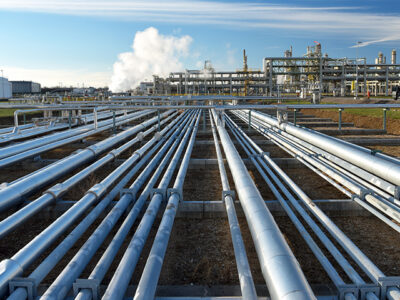
Prevent piping fatigue failures with on-site vibration surveys from Equity Engineering’s certified ISO VCAT-IV analysts. We assess small-bore connections (SBCs), evaluate flow-induced vibration, and screen process piping for vibration fatigue using fitness-for-service (FFS) methodology. Our motion amplification video (MAV) technology optimizes piping support locations while performing remaining life assessments, delivering ASME B31-compliant run-repair-replace recommendations that avoid costly piping modifications.
Download the Rotating Equipment, Vibration, & Dynamics Overview here.
When is That Shimmy or Shake Okay?
Piping vibration is often random and is drastically different than the constant amplitude or multimodal vibrations found in rotating equipment. Knowing where to look and understanding how long the piping will continue to operate under the existing conditions is key to preventing failures.
At Equity Engineering, our engineers conduct on-site piping and structural vibration surveys and testing to evaluate the equipment, assess the risk of vibration, and provide recommendations to mitigate vibration fatigue failures.
When to Conduct a Piping or Structural Vibration Survey?
Vibration, especially in piping or other structures, can lead to fatigue crack propagation and eventually equipment failure.
Proactive
If the facility is changing processing fluid or lengthening pipes, it is important to conduct a piping or vibration survey to understand how those changes will affect the fluid flow and frequencies in the piping. Conducting a proactive vibration survey is an essential part of an evergreen mechanical integrity program.
Reactive
If you notice a pipe or supporting structure moving under normal operating conditions, it’s important to conduct a survey as soon as possible. Our vibration experts will diagnose, evaluate, and mitigate failure risks.
Remaining Life Evaluation & Piping Support Optimization
Analyzing vibration problems with a fitness-for-service (FFS) approach ensures in-service equipment will manage the fatigue risk in your highest risk systems. In collaboration with the Mechanical & Structural Engineering team, we will design temporary or permanent solutions to reduce fatigue risk and extend equipment life.
- Evaluate in-service systems to determine risk factors and make informed decisions on run, repair, or replacement
- Optimize the locations of on-line supports based on vibration measurements and mode shape analysis
- Verify recommended supports comply with ASME B31 while reducing damaging vibration levels
- Improve piping designs to reduce flow-induced turbulence and high-stress, fatigue-prone locations
- Avoid unnecessary and costly piping or structural modifications, such as bracing, by evaluating piping vibration
- Estimate remaining life of equipment using FFS approach
Computational Fluid Dynamics (CFD)
Conduct a CFD analysis to gain valuable insight into the source and location of flow-induced turbulence. Our team will provide you with cost-effective design iterations to mitigate piping and structural vibration and develop mitigation strategies to prevent future failures. Typical CFD applications include:
- Optimization of flow rates and pressure drops in equipment
- Flow instability predictions
- Root cause failure analysis
- Prediction of flow-induced vibrations
- Accurate prediction of heat transfer coefficients
- Efficiency of phase separation in a mixer (e.g., separation of oil from oil-sands slurry)
- Effect of fluid sloshing in a storage tank
Equity’s Proactive Piping & Structural Vibration Workflow
- Screen unit piping and small-bore connections (SBCs) for potential vibration fatigue failures
- Evaluate severity of various operating conditions and identify high-risk piping or equipment
- Utilize the latest motion amplification video to visualize the problem area
- Guide non-destructive evaluation (NDE) inspections by using fatigue assessments to focus on systems most susceptible to vibration damage
SIMFLEX-IV
SIMFLEX-IV, a cloud-based pipe stress analysis software, helps you proactively evaluate dynamic and static piping stresses to maintain integrity and code compliance across your entire piping system. Use the once-through workflow to create piping stress models, visualize geometry and support locations, analyze the effects of both dynamic and static stresses, and compare results to ASME piping code requirements.