Your Inspection Program Keeps Producing Leaks Because It Was Never Built to Find CUI
Undetected CUI is one of the most consistent sources of unplanned downtime, process leaks, and late-stage pipe replacement costs in operating facilities. Most operators already know their CUI program is not working, and the leaks confirm it. The harder question to answer is why. It almost always comes back to the same two problems: the condition monitoring locations (CMLs) were selected for internal corrosion, not external, and corrosion under insulation (CUI) has never been funded like the mandatory program it needs to be.
Special Emphasis vs. Mandatory Programs
Industry codes mandate inspection programs for internal corrosion. They define intervals, require documented corrosion rates, and set inspection effectiveness levels to which operators are held accountable. Internal corrosion receives a mandated budget line because the code requires it. CMLs are created and maintained because non-compliance has consequences.
CUI, however, is managed as a special emphasis program, and as such sits in a different resource tier than mandated program elements. When budgets tighten, mandatory work continues to be funded. However, special emphasis programs can be deferred, de-scoped, or staffed down with zero code violations. While the facility’s internal corrosion program is documented and audit-ready, the CUI leak that follows is not technically a compliance failure, just a potential reportable leak; this is a predictable outcome of how the work was categorized.
Ultimately, that outcome results from process safety management (PSM) history and structure, not the operators working within it. We now have better NDE tools, more sophisticated risk-based inspection (RBI) models, and improved insulation materials, but none of them perform consistently, especially without the organizational commitment proper funding and execution on a defined schedule. A truly well-developed, funded, and executed fabric maintenance program either is not present to begin with, or is easily cut down when competing for discretionary budget every cycle.
The case for treating CUI as a standard program element is not technical – that case was made long ago. Rather, it is organizational, and it starts with how the work gets funded.
The structural problem underneath the budget problem.
Even where budget exists, most CUI programs run on a foundation that cannot support them. The CMLs in most corrosion management systems were built to track internal wall loss, on piping circuits organized around process service and internal damage mechanisms. CUI initiates on the outside of the pipe at locations governed by moisture, temperature cycling, insulation condition, and geometry. Managing both through the same circuit management program produces a program that looks complete on paper while leaving the actual CUI risk largely unmonitored.
A standard UT reading covers roughly 3 square inches of pipe surface. At conventional CML spacing, an internal run-and-maintain program may have less than 2% of the external surface viewed through ports during these inspections. On the surface, if just these ports are used for monitoring, the program appears efficient because little corrosion is visible at these ports. However, the CUI corrosion is at a support foot, a jacket seam, a dead-leg terminus, or a location where insulation has been opened and resealed multiple times. Typical UT ports miss these not occasionally, but by design.
What most programs need is a parallel structure: CUI-specific circuits defined by insulation system boundaries and susceptibility, with CUI CMLs placed according to external corrosion logic.
CUI is a Progression, Not a Binary
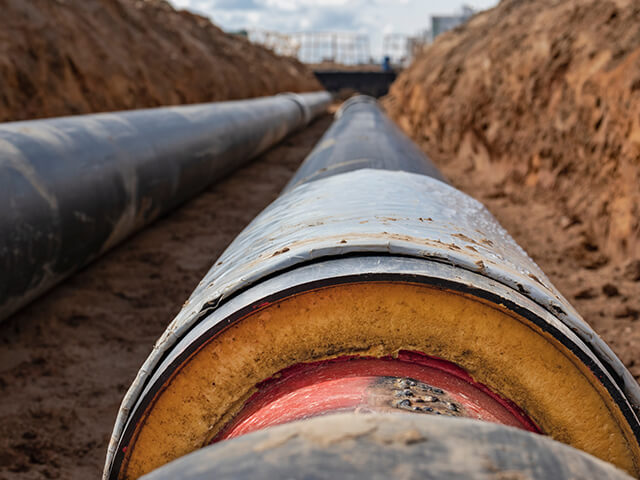
New equipment with original quality coating, insulation, and properly installed jacketing carries negligible CUI risk. As the insulation system ages, moisture infiltrates and accumulates at low points, trapped against the pipe surface. This sustained wetness degrades the coating, and once localized coating failure occurs, corrosion initiates on the base metal at a rate governed by temperature, chemistry, and wet-dry cycling frequency. Without intervention, the sequence ends with a through-wall leak.
Every stage in that sequence is detectable if the program is looking at the right things. Compromised jacketing and wet insulation can be visible through thermography well before through-wall loss occurs. Active wall loss is detectable by RT and pulsed eddy current. When programs find CUI late, it is not because the damage was hidden, but because the monitoring wasn’t aimed at the right stage.
Cyclic service accelerates the sequence. Lines that repeatedly shut down cool down through the susceptible temperature range on every outage, causing condensation to accumulate each time. Welded pipe supports are a specific initiation site because the heat-affected zone is difficult to coat thoroughly, and the inside face of the support is nearly impossible to inspect externally once enclosed by insulation. Austenitic stainless circuits carry a separate risk. Chloride-laden moisture above 140°F can initiate external stress corrosion cracking in 300-series stainless, and older calcium silicate insulation is a known chloride source on any circuit where it remains in service.
The sequence is predictable, the locations are known, and the tools exist to intercept it. The only variable is whether the program is structured to look at the right stage.
Effective Tools, Poor Deployment
Pulsed eddy current screens average wall thickness through insulation without removal. This works for distributed, general wall loss. Unfortunately, the same wall averaging that lets it read through insulation also makes it insensitive to localized pitting, and it struggles at elbows, tees, and small-bore connections – precisely where water concentrates. Guided wave screens longitudinally from a single collar position, identifying sections worth investigating but nothing more. In addition, the method is operator-dependent enough that two crews can survey the same line differently. Thermography finds wet insulation and thermal anomalies, does not measure wall thickness.
The most capable tool is the CUI toolkit is radiography, or RT, and the most underdeployed as a proactive screening method. RT images the full pipe wall cross-section without insulation removal and can detect moisture saturation before measurable wall loss has occurred. That makes it useful earlier in the CUI progression than most programs deploy it. Modern automated RT systems cover substantially more footage per day than manual techniques, which makes circuit-level screening operationally practical rather than ambitious. Using RT only after something else flags a problem means potentially deploying it too late or at the wrong point in the progression, when options are narrower.
What Actually Needs to Change
CUI should be treated as a standard program element with its own budget line, its own circuitization method, and its own assigned CMLs. However, that decision is made above the inspection department – it’s a management commitment, and without it, every technical improvement in the program is running on borrowed time against the next budget cycle.
Build a CUI-specific circuitization, a systematic review of every insulated line against susceptibility factors: operating temperature, service history, cyclic operation, insulation type and age, jacketing condition, drainage, and the location of supports, penetrations, and terminations where moisture ingress is most probable. Then rank the output by CUI likelihood. That ranking system is what screening campaigns can then be built against. Ask, while doing it, whether insulation is even necessary on each circuit. If a line doesn’t require insulation operationally, removal answers the CUI risk question more permanently than any inspection interval.
Next, develop CMLs specifically for insulated circuits. For each location: what technique was used? Was it accessed through the insulation, and is it monitoring external or internal wall condition? CMLs that provide no CUI information get changed to an NDE technique that does gather proper information. Until this effort happens, RBI assessments fed by that data are drawing conclusions from the wrong inputs.
Place CUI CMLs at low points, support contacts, jacket seams, tracing terminations, and anywhere insulation has been opened and re-closed. Treat placement as a living program, broader early in the program while the mechanism’s behavior is being established, concentrated at confirmed high-activity locations once the picture develops. Close the maintenance loop: every insulation opening is an opportunity to recoat and restore the barrier before closing the fabric system. Programs that hand restoration to the maintenance backlog are generating the next CUI initiation site every time an opening closes over bare metal.
When CUI creates a process leak, the inspection record usually looks clear. The affected pipe probably passed its last inspection. The CML readings showed no anomaly. The remaining life calculation was not projecting a problem, and that record is not wrong. The program was accurately monitoring internal corrosion on insulated pipe. CUI was never given the program infrastructure to be properly monitored.
CUI progresses through a detectable sequence, attacks predictable locations, and responds to structured prevention. The leaks are not evidence of a technology gap. They are evidence of a funding and governance structure that has never treated CUI as a first-class program obligation. For owner-operators, the return on a properly structured CUI program is measured in avoided leaks, deferred replacements, and the operational reliability that comes from knowing the insulation system is actually being monitored. Change the classification. Allocate the budget. Build the circuit structure around external corrosion logic. The program will start finding what it was never designed to look for.
Sources and Further Reading
The following Inspectioneering Journal articles informed the development of this piece.
- Overview of Corrosion Under Insulation (CUI)
- Risk Based Management of Corrosion Under Insulation
- Corrosion Under Insulation: Detection Using In-Line Inspection
- Automated Radiographic Testing for CUI Detection
- Finding the Entry Point into RBI
About CorrSolutions
CorrSolutions provides risk-based inspection program design, corrosion data analysis, and mechanical integrity consulting to the oil and gas and petrochemical industries. We integrate field inspection execution, corrosion engineering, and data management to build programs that reflect actual risk, not inherited convention.