INDUSTRY INSIGHTS ARCHIVE

  • Home
  • Industry Insights Newsletter

Reuse Practices, Midstream Engineering Practices, and Other Additions to The Equity Engineering Practices

Corporate standards or engineering best practices are help owner-users manage equipment and facilities by promoting safety, managing risk, improving reliability, capturing corporate memory, and transferring knowledge. In this article, Joel highlights two new collections that were recently added to the Equity Engineering Practices (EEPs) to support clients in the midstream and renewable energy industries, plus he provides a sneak peek into some of the innovative tools currently in development. The EEPs are the gold standard for all your engineering standards needs.

Read More »

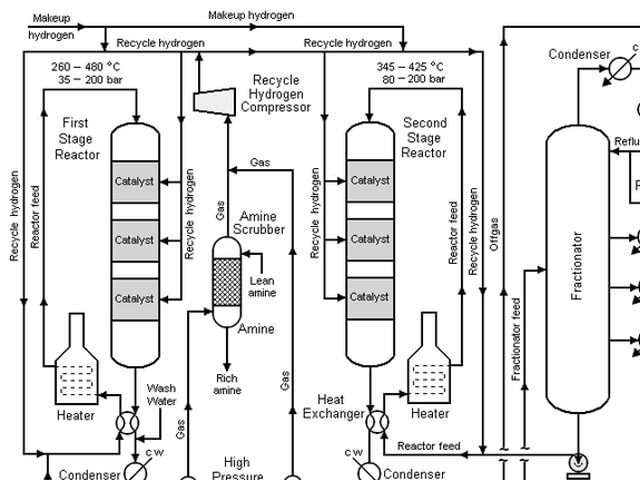
Understanding Operating Limits on Reactor Internals

Hydroprocessing equipment is an important component that helps increase production at refineries. However, during regular operations, the efficiency and run life of these reactors can be compromised by build up on the catalyst surface, leading to costly shutdowns or reduced production. In this article, Adam and Matt discuss how monitoring bed support differential pressure can maximize runtime. They use a recent case study to demonstrate how their analysis of the catalyst bed effectively delayed a shutdown at refinery.

Read More »

Temperature Measurement Hydrocracking Reactors

As more refineries begin to process biofuels, it is important to establish a consistent and accurate temperature measurement program to ensure the hydrocrackers are capable co-processing the new feedstock safely and reliably. In this article, Rohan and Ahmed review the fundamentals of temperature measuring devices and discuss key maintenance and reliability techniques that you can apply to prevent unplanned shutdowns.

Read More »

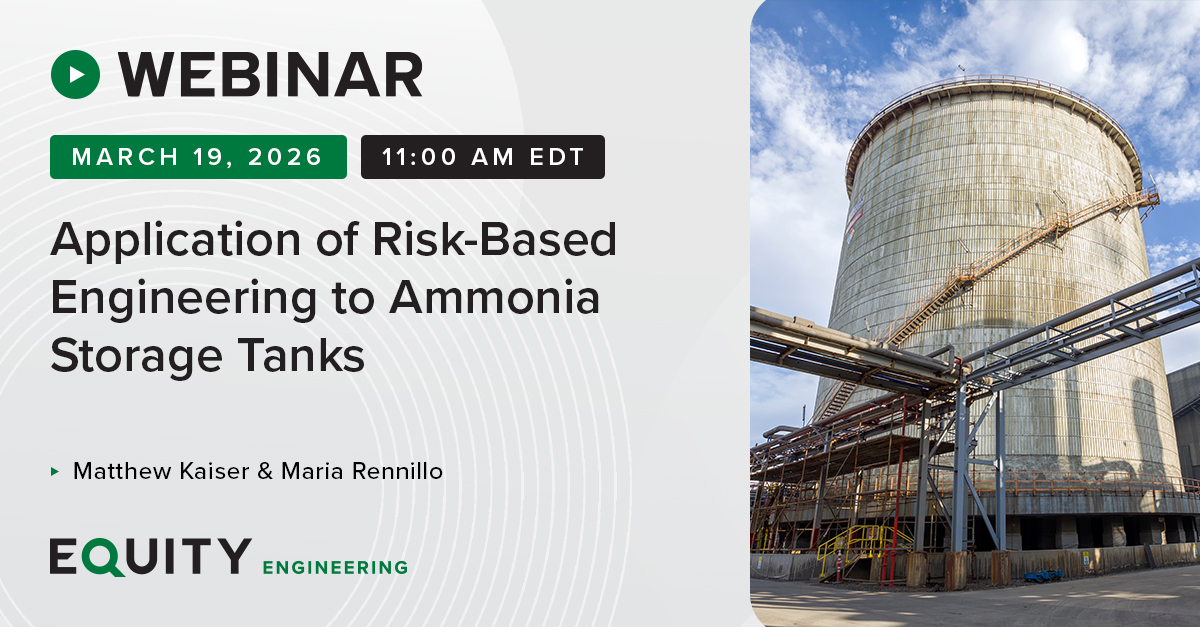
Advancements in Risk-Based Inspection Strategies for Ammonia Storage Tanks

Developing a repeatable, in-service inspection strategy for ammonia storage tanks is difficult; however, it will help improve operational reliability and minimize the probability of failure from several damage mechanisms, including ammonia stress corrosion cracking (SCC). In this article, the authors discuss Equity’s multi-disciplinary approach to navigate the challenges of these high-consequence ammonia storage tanks. Read how we integrate risk-based inspection (RBI), fitness-for-service (FFS), and materials and corrosion expertise to provide a comprehensive and practical inspection strategy.

Read More »

Materials & Corrosion Considerations for Ammonia, Urea, Nitric Acid, & UAN Units

Over the past 20 years, the fertilizer industry has experienced several metallurgical and operational advancements for process equipment. In this article, Raj and Phil discuss the ongoing challenge of damage mechanisms and corrosion-related issues in fertilizer plants and highlight the critical role of materials selection and process monitoring in managing equipment degradation rates. Read more and learn how to achieve long-term equipment reliability and maintain a robust mechanical integrity program through the routine collaboration between materials/corrosion, mechanical, and process engineering subject matter experts and inspection specialists.

Read More »

PSA on PSA Reliability 

Learn how pressure swing adsorbers (PSAs) are crucial yet challenging in gas separation, and how a comprehensive lifecycle management plan based on engineering and fitness-for-service (FFS) can enhance reliability and extend equipment life. In this article, Neal and Kate discuss the importance of remaining life and inspection optimization studies in managing severe cyclic fatigue service, highlighting how pre-emptive fatigue studies guide inspection plans for PSA vessels. You will learn about inspection strategies and how to maximize capital investments through engineering strategies.

Read More »

Understanding Damage Mechanisms in Industrial Gas Applications

Metallurgy and corrosion experts a key to identifying damage mechanisms and predicting corrosion rates for equipment used in processes like steam methane reformers (SMRs) and air separation units (ASUs). In this article, you’ll read how important it is to recognize which damage mechanism can be reasonably captured with risk-based inspection (RBI) methods and which ones require more detailed analysis using FFS principles. In addition, you will also gain insights into how to create robust mechanical integrity programs for industrial gas production units.

Read More »

Case Studies of Failures in Crude / Vacuum Units

The contaminants found within crude oil can lead to numerous types of damage mechanisms that impact the crude unit. Unfortunately, multiple damage mechanisms can be the cause of an in-service failure. In this article, two case studies discuss the need to conduct in-service failure analyses for uncovering the root causes and developing practical risk mitigation strategies.

Read More »
Generic selectors
Exact matches only
Search in title
Search in content
Post Type Selectors
Pages
Industry Insights Newsletter Articles
Events
Library Items