INDUSTRY INSIGHTS ARCHIVE

  • Home
  • Industry Insights Newsletter

New Guidance for the Design of Fillet-Welded Patches

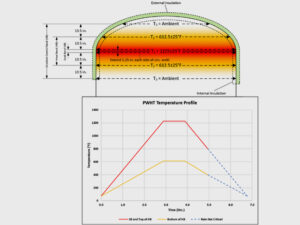
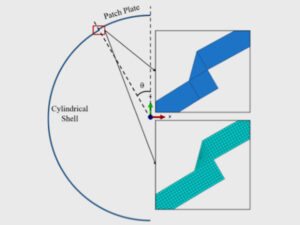
The current ASME PCC-2 Article 212 guidance for fillet-welded patch repairs is known to be conservative, frequently driving patch plate thicknesses past the 1.5-inch threshold that triggers mandatory PWHT. This article presents Equity Engineering’s proposed T-min methodology, an FEA-validated alternative that eliminates unnecessary thickness penalties and reduces PWHT risk while remaining technically rigorous and grounded in ASME design-by-analysis principles.


Read More »

Bolted Flange Joint Assembly and Integrity

Learn how to improve performance by adopting inspection and maintenance best practices and applying advanced finite element analysis (FEA). This article discusses key design and operational considerations, drawing from codes and standards as well as Equity Engineering’s experience in assessing bolted joints. 

Read More »

Educating the Next Generation – Training SMEs

Integrating cutting-edge solutions into proactive knowledge-sharing programs ensures the seamless transition of expertise from retiring subject matter experts (SMEs) to the next generation. Read about ETI’s mechanical integrity and lifecycle management training designed to increase knowledge transfer, while also helping engineers learn new technologies and achieve operational excellence.

Read More »

Damage Review and Risk Assessment of Midstream Amine Processing Units

For those who had the opportunity to watch last week’s webinar presented by Brian and Shane, this article expands on the benefits of risk-based inspection (RBI) for amine processing units and offers a multidisciplinary approach. It begins with an overview of the process and rich/lean amine loading, identifies key damage mechanisms and areas of concern, and proposes options for corrosion mitigation.

Read More »

Advancements in Risk-Based Inspection Strategies for Ammonia Storage Tanks

Developing a repeatable, in-service inspection strategy for ammonia storage tanks is difficult; however, it will help improve operational reliability and minimize the probability of failure from several damage mechanisms, including ammonia stress corrosion cracking (SCC). In this article, the authors discuss Equity’s multi-disciplinary approach to navigate the challenges of these high-consequence ammonia storage tanks. Read how we integrate risk-based inspection (RBI), fitness-for-service (FFS), and materials and corrosion expertise to provide a comprehensive and practical inspection strategy.

Read More »

Understanding Damage Mechanisms in Industrial Gas Applications

Metallurgy and corrosion experts a key to identifying damage mechanisms and predicting corrosion rates for equipment used in processes like steam methane reformers (SMRs) and air separation units (ASUs). In this article, you’ll read how important it is to recognize which damage mechanism can be reasonably captured with risk-based inspection (RBI) methods and which ones require more detailed analysis using FFS principles. In addition, you will also gain insights into how to create robust mechanical integrity programs for industrial gas production units.

Read More »

Optimizing Corrosion Monitoring Programs with Bayesian Analysis

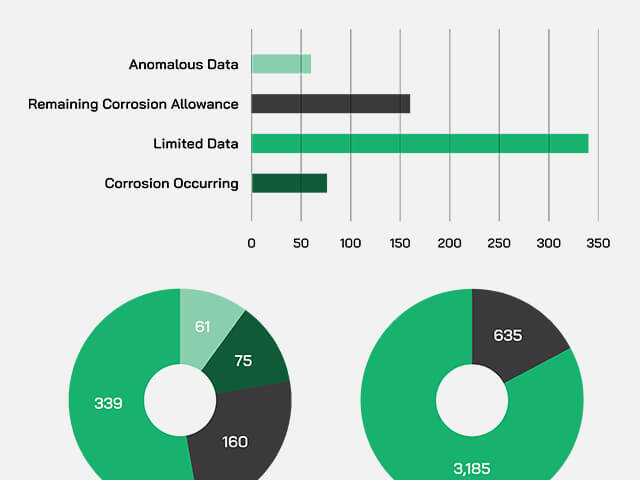
In this Industry Insights article, Rob Clarke uses a case study to explain how advanced analytics and expert collaboration revolutionized asset integrity management, setting a new standard for industry excellence. You’ll read about how a facility transformed its corrosion monitoring program using CorrSolutions’ BOAR analysis to enhance efficiency and develop proactive maintenance strategies.

Read More »

Inspectioneering: Damage Management Locations (DMLs) – Connecting Inspection Data with Asset Lifecycle Management

We’re highlighting an article written by David A. Osage from the Inspectioneering Journal’s July/August 2023 issue, in which he discussed E2G’s new inspection scheduling methodology that is reshaping asset integrity and equipment lifecycle planning and management. Using his vast knowledge and expertise in fitness for service (FFS), David outlines how E2G’s groundbreaking new maximum allowable working pressure (MAWP) approach aligns with API 579-1/ASME FFS-1 standards, ensures integrity with continued operation, and works with the damage classes listed in API 579.

This article appears in the July/August 2023 issue of Inspectioneering Journal.

Read More »
Generic selectors
Exact matches only
Search in title
Search in content
Post Type Selectors
Pages
Industry Insights Newsletter Articles
Events
Library Items